

Risk Of Foundational Knowledge Beyond 2026

By Victor Kuarsingh

AI is pushing the boundaries of technological abstraction further than ever before. While no one is arguing we should abandon modern tooling and code like it’s 1965, this rapid evolution introduces a silent organizational risk. Every previous era of computing has shown that when an abstraction breaks, the organizations that are impacted most are the ones where technology creates problems and few or nobody is left in the building can reason about what is underneath.

The Challenge Ahead

When we look back over the past 60-70 years, the industry has come a long way from our early computing and programming era.  In those early days, the application user was most often the code developer with a necessarily deep understanding of the foundational computing system by which functions were built.   As operating environments evolved, such as the release of Unix by AT&T Bell Labs in the 1970s, programmers and users were able to leverage a more abstracted environment resulting in productivity gains. As we approached the 80s, that further evolved where end users were rarely the programmer, and even more unlikely to have a deep understanding of the foundational computing platforms. 

In the 1980s, the acceleration of networking was driven by the need to expand the early ARPANet that bloomed into the Internet by the mid 1990s.  Those early networking experts were most often computer scientists that formed early connectivity protocols and systems morphing into a defined discipline by the mid-1990s.  Early networking talent, just like the early systems and programming talent, was often very well versed in the foundational infrastructure’s base architecture, design and capabilities. Moving further into the 2000s, the rapid expansion of vendor supplied products, standard deployment models, and further abstraction began to distance users, administartors and programmers of networking systems from those foundational capabilities. 

The advantage of these abstractions both within the software and networking space were revolutionary in allowing for scaling and acceleration of deployments, modern applications and outcomes.  However, an artifact of this change is the slow and often silent deterioration of foundational expertise in many businesses. Areas where experience often now lacks includes networking, security, computing, operating systems and platforms.  The deep learning curve that was needed to be functional years ago, no longer is mandatory for most designers and engineers to operate within their areas of the business.  That separation and devolution of “making it work” contrasting to understanding “how it works” – poses a risk to business, especially when those foundations are needed for resiliency and overall business success.

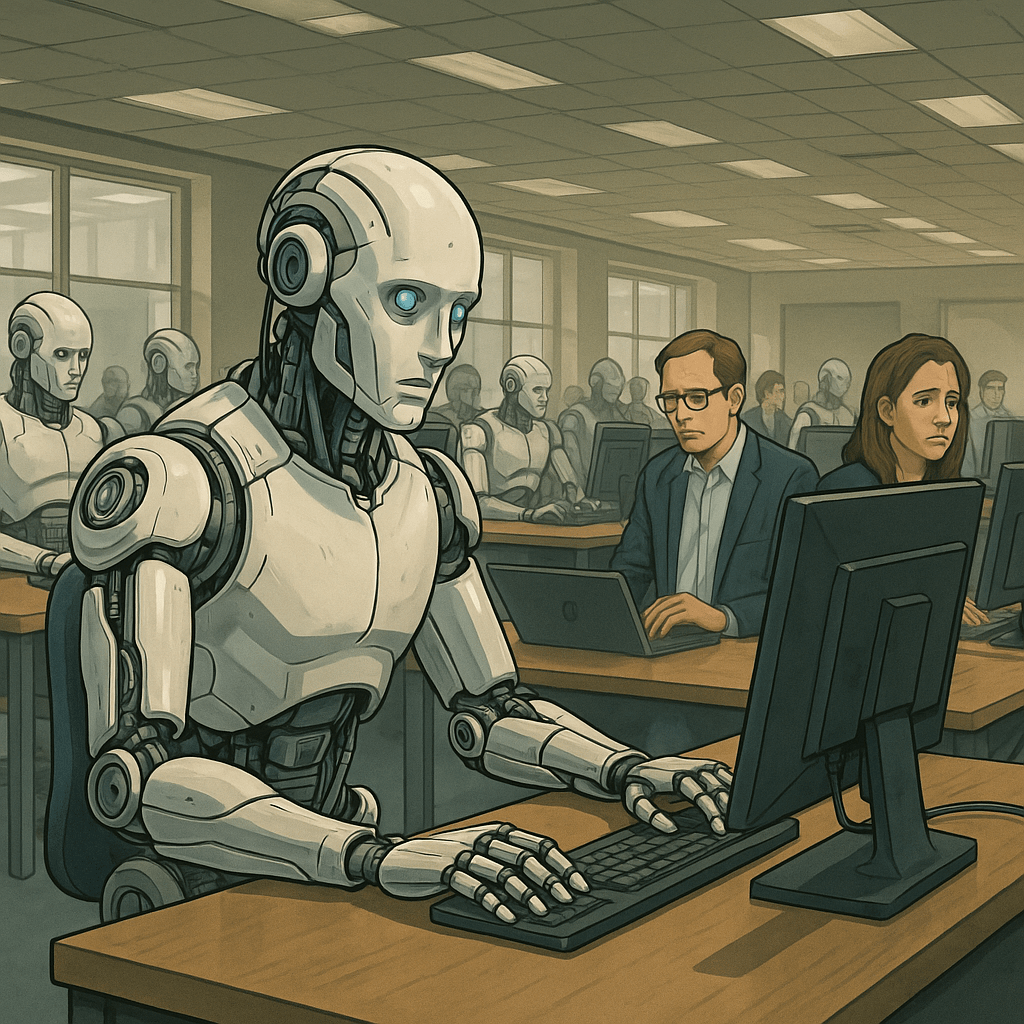
AI, which has displaced so many foundational tasks and roles, not only further adds to the separation, but may further accelerate the deterioration of skills development and growth of cognitive reasoning when designing, using and improving systems or platforms.  The new risk somewhat exacerbated by AI is the release of engineering rigor as a pillar of development teams are able to produce without really knowing how the product (code or config) is being generated.   

With a declining population of highly competent engineers that understand the foundations, and an ever increasing demand for those people, its going to be interesting to see what transpires in the market and in businesses.  Early impacts will likely be filled with outages and missed opportunities for businesses.  The longer term impact may be foundationally  anemic businesses unable to produce substantive products and services relegated to producing fragmented and unreliable technical products.   The challenge we face as business leaders is – can we leverage AI to accelerate now without sacrificing our future success.

Modern examples where eroded engineering rigor and abstraction-layer failures caused significant business impact include CrowdStrike (2024), Meta (2021), and Knight Capital (2012) — each resulting in substantial financial loss and reputational harm.

So What

The challenge we face as leaders and within the Industry is clear.  We must leverage AI to accelerate our velocity without sacrificing our future integrity.  We need deliberate balancing between embracing this new layer of abstraction while still protecting our base of needed expertise. 

Allowing AI to completely sever our engineering teams from the underlying mechanics of our networks, systems, and platforms introduces a business risk. When a catastrophic failure inevitably occurs beneath the AI-generated layer, the absence of deep, cognitive reasoning won’t just cause a routine outage—it could result in an entirely unrecoverable situation where no one in the building knows how to rebuild the collapsed foundation.

AI can generate the code and configure the platforms, it cannot assume the risk. Moving forward, engineering rigor cannot be outsourced. We must intentionally cultivate, value, and retain the talent that understands the “how,” ensuring that as our technology becomes increasingly abstracted, our ability to govern, troubleshoot, and recover our businesses remains firmly intact.

Rethinking the Network Engineer Part 2: From Builders & Administrators to Software Innovation

By Victor Kuarsingh

Introduction – The Shift Beyond Building and Administration

For decades, network was largely anchored to an administrator’s perspective: building, configuring, crafting and maintaining systems with the mindset getting to runtime and keeping the lights on. This approach solved immediate problems effectively, but it also constrained networking to incremental change and reliance on humans for many operations even if some automation was present. Today’s landscape that includes cloud, automation, distributed systems, edge computing and complex security; demands a substantive change in how we build systems. The future of networking is no longer about administering devices; it is about engineering solutions at the software layer, with networking as one of several domains in play.

Lessons From Past Practice – Why the Old Model No Longer Fits

Traditional approaches relied on command-line mastery and vendor-specific skills. These were critical in the 1990s and 2000s, but they locked engineers into reactive modes of work: troubleshooting configurations, responding to outages, or scaling networks by manual effort. Basic building and management of networks can be argued to be a “solved problem” insomuch that there is an abundance of operational techniques and tactics known by our industry to deal with them —protocols, routing methods, and device management frameworks exist that address the common cases. What remains unsolved are the problems of scale, velocity, and flexibility in the face of continuous change. These are not CLI problems; they are systems design problems.

Innovation by Inquiry – The Engineer as an Explorer

To move forward, network engineering needs the same culture of inquiry that drives innovation elsewhere. Extrapolated lessons from my post on Innovation by Inquiry, the emphasis should be on asking questions that reframe the problem space. So questions like – Why is this process manual? How could it be automated? What would a system look like if it were designed as code from the ground up? – are great ways to frame how to apply innovation to a problem.  This mindset turns engineers from operators into explorers, willing to experiment, fail, and iterate. Software engineering brings the tooling—automation frameworks, APIs, CI/CD pipelines—but inquiry provides the compass to ensure those tools are used to solve meaningful problems.

The Case for Network Engineers as Software Engineers

The emerging reality is that network engineers must become software engineers who also understand networking. Not the other way around. Writing infrastructure as code, modeling traffic flows as software artifacts, and integrating with service-based architectures are now table stakes. A software-first engineer can scale networking far beyond what was possible with administrator-centric practices. They can build abstractions, enforce policy through automation, and design resilient systems that are tested, versioned, and repeatable—just like any modern application. Networking knowledge remains essential, but it is no longer sufficient on its own.

Shifts We’ve Made Before – Reinvention Is the Norm

This isn’t the first time networking has reinvented itself. In the 1980s, networking often emerged from system administrators wiring together early LANs with technologies like Ethernet (IEEE 802.3), ARCNET, Token Ring, etc – solving the basic problem of how to connect PCs and share resources. By the 1990s, the explosion of the Internet demanded new thinking about the physical and routing layers. Vendors like Cisco and Juniper built high-capacity routers to support the first backbone networks, while advances such as fiber optics and DWDM (Dense Wavelength Division Multiplexing) reshaped how bandwidth could scale displacing early SONET and ATM technoloiges. Entering the 2000s and 2010s, the challenge shifted again: distributing and accelerating content. Content Delivery Networks (Akamai, Limelight), broadband build-outs, and global peering fundamentally changed how information was delivered. Each stage forced a leap away from past practice.

Today, the limiting factor is not physical speed but complexity—interconnected systems, microservices, cloud-native architectures, and global scale. Managing that complexity requires more than manual configuration or incremental improvements. It requires software: abstractions to tame complexity, automation to eliminate toil, and orchestration to ensure resilience. Just as we rethought wiring in the ’80s, backbone scale in the ’90s, and content distribution in the 2000s, we must now rethink networking through a software-first lens.

Forward-Looking Examples – Signs of the Next Shift

The industry is already showing us where this evolution is heading. Hyperscalers such as Google, AWS, and Microsoft have moved to intent-based, API-driven network models, where engineers declare desired outcomes and automation systems translate that into actual network states. Emerging 5G and edge networks rely heavily on network slicing and service orchestration, concepts that cannot exist without a software-first approach. These examples prove that the shift isn’t theoretical—it is already happening, and it rewards those who can think in code while understanding the fabric of connectivity underneath.

The unique challenge

The challenge—one somewhat unique to this space—is how to encourage a larger segment of networking innovators to adopt and excel at software-based approaches to solving problems, while still maintaining deep proficiency in foundational networking concepts. Developing such a polymathic, interdisciplinary skill set is difficult; this transition will be challenging to both foster and sustain. It takes years to become proficient in networking, and likewise to master the craft of building reliable software—yet our industry must rise to meet this dual expectation.

In many ways, this moment feels like a return to our roots. During the mid-to-late 20th century, it was computer scientists who designed many of the the early networks and the protocols that made them function. Perhaps it’s time to rekindle that spirit—to begin again with a software-first mindset.

Structuring the Future Differently

The shift is not optional. If we keep structuring solutions as administrators, we will keep solving yesterday’s problems. To address tomorrow’s, we must structure solutions fundamentally differently—through code, inquiry, and engineering discipline. This is not just about personal skills, but about reshaping the culture of networking teams to value experimentation, automation, and systems thinking. As with any transformation, the leaders who thrive will be those who combine the technical fluency of software with the critical inquiry of innovators, shaping networking into a platform for the next era of digital infrastructure.

Will AI take my job?

By Victor Kuarsingh

While the current buzz around AI has sparked curiosity for some and absorbed the attention of others, it has also created a sense of fear among those who believe AI may ultimately replace their jobs. There is of course a class of people who may not know what to think.

While the exact path of AI’s integration into the modern workplace remains uncertain, one thing is undeniable: its capabilities are accelerating at a staggering pace, and the disruption it brings is no longer a question of if, but when, how and where.

Highlighted in Our World in Data (Data source: Kiela et al), by 2023 AI was already outperforming [average] humans in reading comprehension, image recognition, and language understanding—while matching us in handwriting recognition, and speech recognition. Predictive reasoning, math problem solutioning, code generation and complex reasoning were all getting close. And that was two years ago. Since then, AI’s capabilities have been doubling every ~7 months, according to Metr.org with AI’s ability to accomplish larger tasks.

Some argue that focusing on labor-intensive work or roles that seem to inherently require human involvement might offer temporary protection from AI and related future automation. Yet, advances in robotics are rapidly encroaching on even these opportunities.

While none of us can predict with certainty what the next 5–10 years will bring, one thing is clear: the ability to adapt, evolve, and embrace change will be essential for achieving success in the workforce of the future. So to answer, “Will AI Take my job?” – Maybe.

References:

Measuring AI Ability to Complete Long Tasks (METR)

AI Test Scores (Our World in Data)

Everyone deserves a mentor

By Victor Kuarsingh

Do you remember a great teacher you had in school?  Perhaps you have fond memories of a caring and understanding older sibling, relative or a parent.  No mater whom it was, you may remember the time, care and interest they took in you;  helping you grow as a person.  Well, often, that type of relationship can be considered one of a mentor and mentee.  For those lucky enough to have had such a relationship, it can mean the difference between success and failure.  Such persons likely saw past your your limitations, understood your capabilities and helped you realize your potential.


Such a relationship need not be limited to the home, school or amongst family.  Mentorship is a skill and aptitude that is able to build up and grow employees within a business as well.   For this blog, we will focus on mentorship in the workplace.   Why do we mentor?  Why should one care? What is the benefit?  All good questions to be addressed in this short blog.


First, just like ourselves, most people were not born with the refined skills they possess as they moved throughout their careers.  Skills, methods and patterns are learned, adopted and taught over the course of time.   Some people are more able to build skills based on their own ability to absorb  information and adapt;  whereas others may need more assistance.  No matter whom we are, even if we are the more self sufficient type, we should realize that people are more than capable of growing, if given the chance and receive the right mentorship.


Each skilled leader should realize that talent within their organization is ripe for growth and advancement, if only provided mentorship to unlock that potential.  So why do we do this?  Great leaders realize that one of their jobs is to grow talent.  Its the duty of each leader to understand their role in building organizations, of which, building better managers and contributors are an essential part of those duties.  


So is duty the only reason for this role as leaders?  No.  Often leaders are in positions where they need to advance a business, improve operations, grow capabilities and achieve other key objectives of the business.  To achieve these goals, one must realize that they only have 24 hrs in a day.   Even if one could personally achieve  super-person status, able to spend almost every waken hour working, you will still run out of time and can never put in more that 24 hours in a single day, and more realistically 10-14 if you forgo most other activities.   The only real way to truly grow an organization is to focus on building other leaders who can expand the impact of your group or function.  In this model, what was once one person’s output now becomes a team’s output.   Suddenly, with proper mentorship, nearly a limitless amount of hours, only capped by the number of people one has working with them, can be spent improving an organization and reaching business goals.


What is the benefit?  Well as discussed in the previous paragraph, organizational success is of primary benefit.  However, if one looks at the selfish aspect of  the equation (which many often do), there is another benefit as well.   A leader’s ability to increase scope and take on new challenges can be tied to good mentorship and making your team self sufficient.   Great leaders are always building an organization that dose not need them.  Why, because this unlocks the leader to continue to grow while the success of their team is realized by a well mentored team.

So in summary.  Why should you mentor as a leader?  First, because its your duty.  Second, it will allow you to achieve your business goals (unless you are a singles tennis player, in that case, you are a lone wolf).  And thirdly, you automatically put yourself in a position to advance and take on more.

Network scale, don’t get left behind

By Victor Kuarsingh

Picture: Carmo Convent Ruins form earthquake of 1755

What’s old is new again, so some have said. It is interesting to see how even in 2020 we continued to hit capacity walls with the sudden change in demand for one of the most precious resources on the Internet and inside networks – bandwidth. Clear to most is the trigger, COVID-19, for this onslaught of additional bits hurling across the networks.

In February 2020 many knew that something was brewing when news continued to flow that the new virus known as SARS-CoV2 was devastating Wuhan. What we did not know, at least not to any degree of certainty, was the sudden shift in demand as a large swath of the office going workforce hunkered down at home and began to use video conferencing as their main interface to conduct meetings, Interviews, and other work. Whereas some may claim this was a surprise that none of us could have foreseen, the phenomenon of a sudden shift in demand is not a new one.

Lets enter our virtual DeLorean, turn on the time circuits and enter the date 1985. Oh wait, that’s too far back! Lets set it for 20 years later, so 2005. Now that we are in 2005, our story begins. I recall many conversations as the rumbling began to emerge of this new phenomenon called YouTube. Until then, we saw the rapid, yet gradual increase of bandwidth within the ISP networks throwing caching infrastructure to help manage the customer’s experience while we applied the 2000s model of building out the broadband networks and peering needed to sustain our normal for that time. However, YouTube changed all that. Suddenly, the capacity models broke. It was increasingly hard to keep up with the customer demand for bandwidth as demand started to consume much more bandwidth per user than before. This demand was really new, and before that, the concept of mass customer generated content was really not a something we engineered around. Facebook had also hit the scene, but other than fighting for supremacy versus MySpace, it did not seem to push as many bits to the network …. yet. Many of us planning network scaling realized it was hard to predict what will drive demand for our networks especially since the use case was new and not predictable.

We learned our lesson and everyone worked perfectly since then. Well, not really. lets climb back into our fictional metal time machine and advance to the year 2010. Although Netflix streaming has started in the US prior to that year, in Canada (where I was at the time), Netflix hit the wire. Again, there was a massive shift in demand for the network. Traditional content distributors were baffled by the love for this pay service that seemed to have benign content, but a large audience none the less. Unlike models that worked for pay-per view and traditional movie rentals, streamed from more traditional ISP systems, this demand was different. People behaved differently and the old world of sitting in front of the TV at defined times to consume movies was displaced by watching content on other devices at any time. This seemed to also spawn the new social act of binge watching. Around the same time tablets hit the market, and as the next few years rolled on, people started to consume streaming services on many devices and families began watching content in parallel, putting pressure on the network once again. So finally, we got it, nothing left to learn. Once again, not really.

We don’t need to climb back in our our DeLorean again since around the same time over in our Wireless networks we saw a different transition hit. Smartphones had displaced older phones that often used WAP and now people were using their phones for content. These were not ordinary phones either, they were smartphones which were driven by Apple’s push in 2007 with the first iPhone. The old saying of “how many T1s do we need for that cell tower” was no longer sufficient to address this insatiable demand for bandwidth. New technology had effectively allowed people to use the Wireless network for new functions which of course included content viewing. Once again, the race was on to upgrade the Radio Access Networks, Wireless core, transit uplinks, peering and other network services. Often older network designs did not cut it, and new topologies and designs needed to be rolled out to address the demand for network bandwidth.

What was the point of this stroll down memory lane? Coming back to 2020, the lesson is that we cannot reliably predict demand as well as we think we can because new demand is often based on new phenomenon which we cannot model before we are exposed to it. If I told you last January (2020) that the vast majority of office personnel were going to work from home and use video conferencing you would likely have challenged me. So, what can we do if we can’t predict new demand based on existing models? Well one way is to just accept that things will happen and we need to shift and respond to new phenomenon. But business leaders and designers can do something more. When we produce our network and system designs and network scaling plans, we should do so with an expectation that we may need to not just scale our infrastructure based on known models. We should understand how we would scale for models based on ‘what-if’ scenarios which look like 10x, 20x, 50x and even 100x of our current network and service infrastructure. Businesses may not have the funds to support an advanced build out of capacity; however, we should know how we will get there if we need to. Waiting for the next emergency to figure out how to scale outside of our known curve is a sure fire way of getting left behind by those who can respond.

Leaders need to run these what-if scenarios, understand what technical constraints may exist, what business constraints may need to be overcome, and what time scale needs to be factored into achieving such goals. It is possible that some of the blockers cannot be addressed with current technology, funding or workforce, but knowing what needs to be done can be very helpful. Perhaps even knowing how to address one or two challenges with others left for future solutions can still provide a head start when a sudden scaling crisis arrives. If leaders find that they cannot deal with such scenarios such as a 10-100x increase in demand, then a hard look at what we have built may be in order. Making design changes and producing processes to scale even under extreme multipliers is best done before the emergency is upon us.

So practically, what can get in your way? What should a leader be aware of? First, do the designs in place support scaling, even at one to two orders of magnitude? If not, does it require a clean sheet design or are changes sufficient to meet such needs? Second, do your vendors have equipment types that support such a large change in capacity? If you use your own hardware, you would ask yourself the same question. What would supply chain need to look like? Especially Should extra or new equipment be needed? If you need to leverage a new vendor, have you put in the needed work to onboard that to fit the provisioning, configuration, management and operational models? Is training needed, especially if it relates to new potential hardware or software if deployed. If massive expansion is needed, are power needs able to be satisfied? What about time to build? Labor is often a challenge, especially during periods of high demand. There are many other self reflecting questions one can ask within their organization, but the important point is that leadership ask these in advance, and understands what is needed to provide a reasonable answer to them.

What will drive your business may be unique to what you offer, it may be related to more global drivers and behaviors. Never assume we know what’s next because the Internet and the industry in general has a weird way of teaching us that we can’t predict the demand of the future. If you ask me what’s next? 5G will likely continue to unleash new types of demand that are unlocked by having rich bandwidth resources and new application options opened up. Depending on where you play in the industry, you will want to figure out what that means for your business. Cloud acceptance is also continuing to gain acceptance to CIOs and CTOs, many of which were weary of such migrations just a few years ago. This impacts scale and performance. Ask hard questions now, before the next demand shift occurs.

To explain why I used the Carmo Convent ruins picture above, which I took while in Lisbon a few years ago, is a way to highlight crisis and preparedness. The initial impact of the 1755 quake was devastating. However, the ensuing inability to deal with fires throughout the city and recognizing the receding waters meant a tsunami was coming had caused much more impact than necessary. We may not always be in a position to eliminate all impact, but preparedness can help us avoid additional impact which can be managed with the right foresight and planning.

Data Center routing simplicity with LSVR

By Victor Kuarsingh, Co-Chair of Link State Vector Routing (LSVR) group at the IETF


Data centers have continued to drive the focus of innovators and practitioners of data center builds. With the every growing need for more data center capacity for cloud offerings or enterprise data centers, the extended need to support both massive scale and maintainability have never been more important. Operators continue to face the ever present need to build infrastructure that scales, however, the ability to configure, maintain, troubleshoot and resolve runtime problems is just as important as that need to build.


One recent development in some large scale data center networks, is the focus on building generic and scalable fabrics based on CLOS fabrics. This type of underlay network allows for scaling of the data centers using battle tested and simple to apply principles. A nice outcome of this mode is that it can also assist in providing vendor independence for operators in addition to the achieve massive scale. Another decision made by some of these large data center builders is forcing simplicity into the protocol layer of the network fabric as well. The decision there has led to the wide use of BGP, and in some cases, no underlying IGP at all. It is this second aspect of the large scale data centers that is of interest.


Why? Well, for years, I recall many architecture and design level discussions seeking to add more capability into the network, helping add and improve functionality. We had IGPs working, overlay technologies such as MPLS/VPN, needed QoS, and pushed a raft of improvements into the relative protocols to help round it all out, and iron out issues we faced by forcing additional complexity into the network.


As we hit the 2010s, a shift was well underway were we pushed much of the complexity into the overlay network. This left the underlay network relatively untethered, providing an opportunity to simplify the design. Even more recent improvements, such as pushing overlay technology purely into the software realm has also led to much faster progression of overlay capabilities which detached it from the more cumbersome and slow process of upgrading and updating network hardware.


In the most extreme examples, one can find network underlays that run nothing more than a single routing protocol – BGP. That can be assisted by a way to manage the device such as SSH and NETCONF and provide needed neighbour discovery using LLDP. In that model, no IGP is needed or even desired, with the trade-off granted to simplicity. This very basic model does lose out on some capabilities that you get with an IGP, however, in the world of cloud, many of those capabilities aren’t really needed for the underlay and the larger goal of simplicity and stability are much more important than finesse and speed.


In this extreme example, because BGP was not originally intended for this lone purpose of routing just internal traffic with no underlying traditional IGP, we are left with a few gaps in efficiency. This is where Link-State Vector Routing (LSVR) comes in. What is LSVR? Well it is BGP with some modifications to update how routes are calculated. Anyone using BGP in its modes of operation would be quickly familiar with LSVR. From a confirmation and behavior perspective it is BGP. In that world, we continue to support the simplicity of what we get with running as few protocols as possible on the underlay network, but also gain the efficiency of vectored routing on the underlay normally supplied by a full fledged IGP. The objective is not to gain the same level of protocol efficiency as an IGP, but maintain the much more lucrative and hard to achieve goal of operational simplicity with added efficiency.


The fewer things that need to be configured, updated and maintained, the better off an operational environment will be. There are fewer things to put into configuration models, less hurdles in integrating multiple vendors (only one routing protocol) and less protocols needed to be secured and troubleshot. Another benefit of this approach is that is uses a familiar protocol like BGP which we need to use anyway for exterior routing. Teams can onboard this new functionality with little new complexities to learn outside of the architects of the organization which would often need and want to understand the nuts and bolts of any protocol. However, the vast majority of the operational teams can continue to use the same simple model with under-the-hood improvements that allow them to keep things simple. And simple, for operators – is really the most important goal as it leads to lower costs and stability.

What is LSVR?

Innovation by Inquiry

By Victor Kuarsingh

Image result for leader helping team

Innovation is a term used widely within the tech industry by individual contributors , managers and leaders alike.  However, such a powerful term is used by individuals with varying definitions.  What I am discussing today is not just technical innovation, as important as that is, but any innovation and approaches to foster such innovation with a focus on leaders in organizations.

I use the term leader purposefully versus manager (or boss) as I see these as different in terms of what they provide to a business, and how they are perceived by the organizations that report to them or follow such individuals indirectly.  Leaders help guide and move organizations in a direction driving positive advancement. Good leaders most often foster the willful and heartfelt desire for people to follow them, work hard for them, and help them achieve a collective strategy and desired set of outcomes.

How could one be a good leader? Well, that is a vast subject with many nuances depending on the domain or aspect of leadership one focuses on. In this particular write up, we are focusing on how to support and drive innovation within a business. I understand that with any set of so called rules we can apply to this topic, there will always be exceptions. Great titans like Elon Musk, Jeff Bezos and Steve Jobs hav, or had, unique styles that were successful – for some definition of “success”. However that style of leadership cannot always be replicated as we all don’t often start our own companies and generate ideas which were optimally timed for unique (or forced) global opportunity.

Many leaders, especially if they are promoted or are managing an organization or function within their area of expertise, may try to over influence innovation and strategy with their own ideas. There is no rule that says a leader should not provoke innovation with their own ideas, however, to gain maximum benefit, one should set the stage and environment for innovation that provides access to a wider set of inputs. What does that really mean?

Firstly, don’t be a “know-it’all”. Nothing poisons the innovation punch bowl more than a leader who attempts to be the master of all ideas expecting their organizations to blindly follow and execute on those ideas irrespective of any erroneous conditions that apply to them. A good leader seeks to first understand what ideas are out there in the ether of their organization. Why is this important? Well no one, not a single one of us, knows everything, has experienced everything, and therefore cannot possibly brainstorm every possible idea of merit. Creating an environment where people can bring forth ideas for consideration, and a process seen to evaluate those ideas effectively, is a first step in innovating by inquiry.

Once those ideas are out, there is much more to be done. The most important components a good leader will often bring to the table is experience and information. In many cases a leader has experience. The experience does not need to be measured in in years, and may be of quality experience (albeit short) where that individual has met problems head on, and found ways to solve those problems. This experience has hidden value in that a good leader will have extracted the process of how the problems were solved and hopefully extracted generic questions that led to the successful answers. Asking good questions, challenging the ideas in a healthy way, and finding validity within the base assumptions or outcomes needs to be accomplished. Driving this conversation is an important role the leader needs to support. A leader also has needed information from within and possibly outside the organization. Normally in any business, leaders are senior individuals within an organization and therefore privy to information not exposed or readily available to others inside that organization. Understanding how business information applies to new ideas is of utmost importance in practical innovation. Applying these two inputs to ideas is an essential input a good leader brings to the overall equation. Contrasting new ideas to how they fit into a generic model of solving real problems can be a great way to tease the ideas out. Also, it can often enhance, focus or affirm innovative ideas for further progression. Mapping this all back the the business (information) is a leader’s duty as well. No matter how great an idea is, a good leader needs to make sure that it can be implemented, fits the business model and would benefit the business or team as whole.

I would be remiss if I did not mention an important concept at this point. That is the notion of – “bring your experience, not your implementation”. I have used this concept for the better part of my leadership career with my teams. One large error I have seen many prospective leaders make is trying to directly replicate past success without first understanding and asking questions on what problems need to be solved in new organizations and situations. Understanding “what problems need to be solved” should precede any immediate action to implement a plan derived in other places or situations. As an analogy (racing world), a great mechanic and new team leader immediately building the best F1 racing vehicle, only to find out they are racing on the Rallycross circuit , would be a sad waste of time and resources and would not deliver overall success. The point? Don’t over rotate your frame of reference to specific past experience or implementations and up-level yourself as a leader and see the forest from the trees. That great mechanic could have built a great Rally car had they first inquired as to the needed outcomes and mission.

Finally, once you have the ideas from the organization, and you have applied needed rigor and information to process those ideas, one must attempt to understand them in practice. Depending on the area of the business they apply to, such as technology, process, products, sales; the practice may differ on how to pilot those innovations. It is important to find ways to test out the innovative ideas for practical implementation. Many successful innovations need tweaks or changes to allow them to bring the most value. Willing to apply risk to the equation, in a tolerable and correctable way, would allow the practical enhancement of ideas before deciding to either shelve them or proceeding further.

As a review, leaders help spawn and guide innovation by applying three key concepts. First, foster ideas from the entire team and organization. Second, apply successful problem solving and user wider information sets in processing those ideas for further development. Third is a process to allow for needed risk taking and failing fast to test out innovations. Of course there will be other models that work and may be more expansive. The concepts noted here are applicable on their own or can be combined with other models to help drive innovation by inquiry.

In closing, effective leaders foster ideas from their teams, help their people succeed, encourage them, and are vested in their success. If a good leader can practice that , their reward , as a leader, will be a healthy set of innovative ideas and a thankful team who are also vested in the success of their leader.

Freedom for all

By Victor Kuarsingh

The debate rages in North America over the need to use face masks when in public to curb the COVID-19 epidemic and how such ordinances infringe on our freedoms.  This debate is less obvious in Canada versus what we see in the US, but don’t be fooled, many Canadians are passive aggressive in their actions and many don’t wear masks.  I would argue from personal experience, the percentage of patrons in local grocery and hardware stores whom do not wear a mask is about the same in Toronto and Miami (shocking for some to hear). 


Does wearing a mask infringe on our freedom?  Well, it certainly can be argued that it does.  However, we need to look beyond simple arguments in this case.  Although we are “free”, none of us exist independent of others.  We depend on society, and society depends on us each day.  So instead of looking at how masks may infringe on your individual freedom, think about how masks intersect with our society’s ability “to be free” as a whole.  


Taking a step back, we need to first all agree that masks may help.  Sure political leaders wavered on recommending them back in February and March, which was sad because they had the needed data to make the proper recommendation. There is enough data to suggest that its potentially helpful, hence why we have doctors wear masks in operating rooms (to protect the patient, not the doctor). Empirically, asian countries have seen much higher success in controlling the coronavirus epidemic and social conformity to wearing masks and distancing is a key differentiator. Unfortunately, local authorities chose to mis-inform society in an attempt to protect PPE supplies early on in the epidemic versus leveling with those in North America – potentially adding significant pain and suffering as a result of their willful dishonesty.  


Now, back to this topic. We don’t wear masks to just try and protect ourselves, we do it to protect everyone else, and ensure we can all live in a free society and support everyone’s ability to move about safely.   This is a key point missed by many who argue against the notion of masks.  These individuals think about their personal freedom and not about protecting a free society.  By allowing the virus to spread uncontrolled, we lose our ability to protect the most vulnerable in our society which includes mothers, fathers, brothers, sisters, sons, daughters, cousins, uncles, aunts and so many more.  If we are all not free, then none of us are truly free.


So when you think about your freedom, think about everyone’s freedom.  Think about what so many young men and women gave up in WWI and WWII so our society could be free.  Those brave souls often gave up their lives and did not think just of themselves when they faced evil in the eye – they thought about everyone else – so should we.  The price of freedom is that we all need to sacrifice at times to attain it.

Privileged, working from home

ballpen blur close up computer
Photo by picjumbo.com on Pexels.com

By Victor Kuarsingh

Following the advancement of COVID19 to full pandemic, many countries around the world took a step back and initiated lock-downs along with other strong measures to limit the virus spread.  As expected, the consternation was quickly followed by trepidation by the sudden change in circumstance and this change also had a large impacts on the job market.

Government quickly stepped in enacting measures to limit the immediate financial impact to people and many businesses pushed their workforce to operate from the “comfort” of their own home.  I noted comfort in quotations since for many, working from home is not very comfortable, nor convenient, and often not even possible.  Many people I have heard from, predominantly in western and affluent society, seem to have enjoyed this opportunity.  They have spacious living spaces, ample access to Internet and were able to achieve a new work-life balance while enduring the confines of lock-downs.

However, for many others, the ability to work from home in comfort, or work from home at all, was a luxury that was not available to them.  I have seen many articles noting that this work-from-home model will be “the new normal”, but I fear those sentiments are artifacts of people who enjoy the privilege of having that opportunity.  We often forget that many jobs cannot be executed from the protection of one’s home.  As a point of reference, those working from home need people how must venture out, to do their jobs, such that they can enjoy that level of protection and ease.

Who are these people?  A non-exhaustive list includes those in our food production chain such as farmers, delivery personnel, processing, wholesalers, retail and grocery workers; as well as others including auto mobile workers, transit workers, emergency service personnel, medical workers, home builders, contractors, just to name a few of the vast army of people who support those that can sit on their couch to get in a day’s work.

Why is this important?  Well, in addition to the privilege of working from home, many of these same leaders and workers seem to also be quite vocal on how we need to maintain such isolation (for their own protection), with little consideration to what that means to others.  I am certainly not advocating pushing everyone back to the streets, but an acknowledgment of the high level of impact and disruption our current circumstance has for people at risk or those who must venture out.  We must also not forget how dependent people who can work from home are on those who don’t or can’t work from home.

The term “privilege” is now used extensively based on a number of events that have shocked us in the past weeks , but that same word applies to many of us who seem to believe that what we have today is sustainable or can even be applied widely as a general reference model.  Having the opportunity to sit back and contemplate such things is in fact an opportunity only granted to those of us who are so privileged.  Think about our neighbors, think about those who must work hard to support our level of comfort and safety.  Also think about all those around the world who could not even fathom of operating like we do.

A whole new world

NewGlobeBy Victor Kuarsingh

The novel corona virus, or COVID-19 which it is most often referred to by the illness it causes, is on the minds of most people today.  Whether the health of oneself, family, or the economic impacts we see, COVID-19 is certainly a major event in all our lives.   

When reading or watching the news, we see a tremendous amount of negative coverage, and given the impacts on our lives, much of that may be warranted.  However, while respecting the people who are affected and have lost their lives due to COVID-19, we don’t want to forget that we are human, and as we have done so many times before, we will not just survive, but learn to thrive again. 

We see the media and other prominent figures saying that “life will never be the same again”, and although that is true, I think many of them are over exaggerating what this means for us.  Even though this will change many of our lives and practices in the immediate term, we will adapt and learn to live with this contagion, and as we have done in the past, we will learn to prepare ourselves for the next event.

Humanity has survived so much in the way of disease, famine, societal issues and wars, and we have always learned to thrive thereafter.  It may not be instant, but we will overcome and better ourselves. I recall, after 9/11 (which was a horrific and inhumane act with unimaginable impacts), we said the world would never be the same again.  That was true. Air travel was not the same after that, but it certainly did not stop. We learned to improve security screening, we developed ways to pre-check people who traveled often and we continued. So, although “life was not the same”, we thrived thereafter. 

If we go back further, say 100 years, we saw the plight of world war.  We learned a lot of lessons in those conflicts, but after the devastation in World War Two, many realized how evil can creep up and cause so much harm, peril and anguish.  Society is now much more observant (maybe not observant enough) and we are more aware of our past and how to keep watch that we don’t let such events occur again.  

What does that mean? It means that we will survive, thrive, grow, and flourish again.  Yes, many will have needlessly lost their lives while we battle this today, but it will not mean the end of our society which has been anchored on our ability to adapt.  Sure, maybe we will need new screening at airports to detect signs of illness and perhaps we will no longer be tolerant of folks traveling when they are sick (we should have done this a long time ago anyway).   We may also learn to react faster, not allowing political correctness to cause us to not put in measures quickly which could limit the spread of a contagion like COVID-19 no matter where in the world it starts from.  We will likely keep many good habits in place such as our washing hands frequently, covering our mouths when we sneeze/cough, and limit our exposure to others if we are ill.   

What else?  We may also remind our society what anti-vaccine positions may cause us and rethink what it means to contribute to the common good by ensuring we maintain herd immunity to known diseases (which were starting to see a resurgence).   We vaccinate, not to help ourselves, but to help those around us as well (many of whom are much more susceptible to illness). In that vein as well, we also can empathize more with areas in the world who may not benefit from the wealth of the west, and give more freely understanding what devastation mass illness can cause.  

We will adapt to enjoy each other’s company again and travel the world.  We will enjoy concerts, dinners, park outings, village gatherings, religions fellowship, office banter and hugs.  It may take some time, we will likely need to make some adjustments, but we will get there. But for now, please consider what we need to do, to make sure we get there – don’t just think of yourself, this is not about you, you are not the exception, this is about all of us together!